


What Is the Printhead Width? A Complete Guide to Thermal Printhead Width
When purchasing or replacing a thermal printhead, one of the most important specifications to consider is the printhead width. However, many buyers are confused by terms such as printhead width, print width, effective printing width, and media width.
Understanding these specifications is essential when selecting a compatible thermal printhead or thermal transfer printhead for a barcode label printer.
What Is Printhead Width?
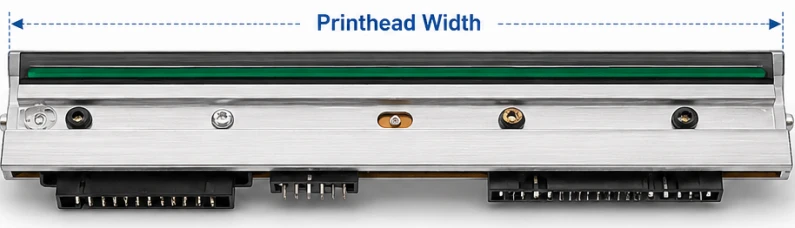
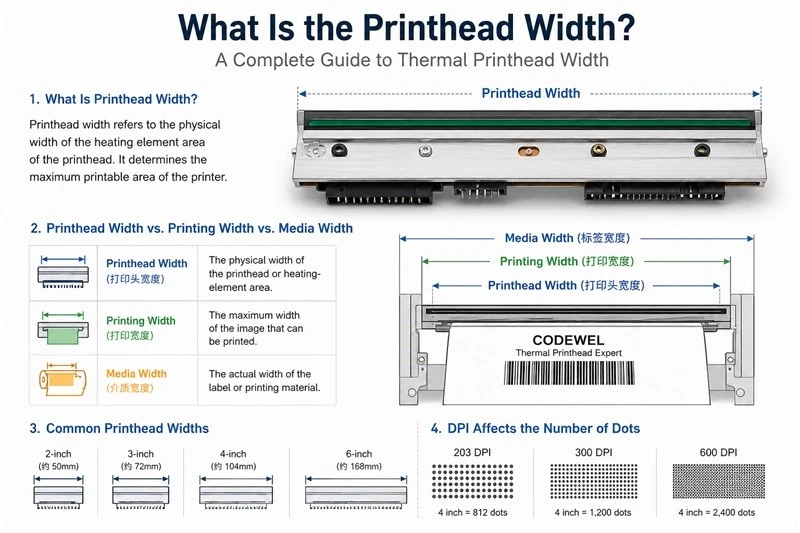
Printhead width refers to the physical width of the heating element area or printhead assembly used to transfer heat onto the printing media.
In thermal printing, the printhead contains a large number of microscopic heating elements, also called dots. These heating elements are arranged in a horizontal line across the printhead.
When the printer activates individual heating elements, they generate heat that creates an image, text, barcode, or other graphics on the label.
Printhead width is normally associated with the maximum printable area of a printer, but the two specifications are not always exactly the same.
Printhead Width vs. Printing Width
| Specification | Meaning |
| Printhead Width | The physical width or heating-element width of the printhead |
| Printing Width | The maximum width of the image that the printer can actually print |
| Media Width | The width of the label or other printing material |
For example, a barcode printer may use a printhead designed for a 4-inch printing application, while the actual printable area may be slightly smaller than the media width.
Therefore, do not select a printhead based only on label width. Printer model and printhead part number are usually more reliable compatibility references.

Common Thermal Printhead Widths
Thermal printheads are available in different widths depending on the printer design and application.
Common categories include:
* 2-inch printheads
* 3-inch printheads
* 4-inch printheads
* 6-inch printheads
* Wider industrial printheads for specialized applications

A 4-inch printhead is particularly common in desktop and industrial barcode label printers.
However, two printheads with similar physical dimensions may still be incompatible because of differences in:
* Connector design
* Mounting structure
* Resistance value
* Printhead electronics
* Dot configuration
* DPI
* Printer firmware
* Printhead identification
Therefore, physical width alone should not be used to determine compatibility.
Does Printhead Width Affect Print Quality?
Printhead width itself does not directly determine print quality.
Print quality is affected by several factors, including:
* Printhead resolution
* Heating element condition
* Printhead pressure
* Printing speed
* Darkness or heat settings
* Label material
* Thermal transfer ribbon quality
* Printer calibration
* Printhead cleanliness
For example, a 300 DPI printhead generally provides finer detail than a 203 DPI printhead when printing small text, detailed graphics, or high-density barcodes.
However, a higher DPI printhead is not automatically better for every application. The correct resolution depends on the printer and the customer's printing requirements.
How to Measure Printhead Width
If you do not know the exact printhead model, you can measure the existing printhead as a preliminary reference.
You can check:
1. The overall physical length of the printhead.
2. The approximate heating-element width.
3. The number of connectors.
4. The mounting-hole arrangement.
5. The label or part number printed on the printhead.
However, measuring the physical dimensions is not enough to guarantee compatibility.
The safest way to identify a replacement thermal printhead is to provide the supplier with:
Printer Model + Printhead Part Number + DPI + Photo of the Existing Printhead
A professional printhead supplier can then confirm the correct replacement model.
Why Is the Correct Printhead Width Important?
Using an incorrectly sized or incompatible printhead can cause several problems.
1. Incomplete Printing
If the printhead does not cover the required printing area, parts of the label may not print correctly.
2. Poor Print Quality
An incompatible printhead may result in:
* Missing dots
* Vertical white lines
* Uneven darkness
* Blurred text
* Poor barcode readability
3. Printer Compatibility Problems
Even when two printheads appear to have the same width, their electrical and mechanical specifications may differ.
4. Potential Printhead Damage
Using an incorrect printhead can potentially cause electrical or mechanical problems. Always verify compatibility before installation.
Thermal Printhead Width for Direct Thermal and Thermal Transfer Printing
Both direct thermal printing and thermal transfer printing use a thermal printhead to generate heat.
The main difference is the printing medium.
Direct Thermal Printing
In direct thermal printing, the printhead heats specially coated thermal-sensitive material directly.
There is no ribbon.
Common applications include:
* Shipping labels
* Receipts
* Logistics labels
* Ticket printing
* Temporary identification labels
Thermal Transfer Printing
In thermal transfer printing, the printhead heats a ribbon, transferring ink onto the label or other media.
Thermal transfer printing is commonly used for applications requiring longer-lasting labels.
Typical applications include:
* Product labels
* Asset labels
* Industrial labels
* Chemical labels
* Barcode labels
The printhead width must still match the printer's design regardless of whether the printer uses direct thermal or thermal transfer printing.
How to Choose the Correct Printhead
When purchasing a replacement printhead, consider the following specifications:
Printer Brand and Model
The printer model is one of the most useful pieces of information for identifying a compatible printhead.
Part Number
The original printhead part number is usually the most reliable reference.
DPI
Confirm whether your printer requires 203, 300, 600 DPI, or another resolution.
Printhead Width
Make sure the replacement printhead has the correct physical and effective printing width.
Printhead Type
Confirm whether the printer is designed for direct thermal, thermal transfer, or both.
Application
Consider the required print quality, printing speed, label material, and expected printing volume.
Conclusion
Printhead width is an important specification when selecting a thermal printhead or thermal transfer printhead, but it should never be considered independently.
For accurate compatibility, buyers should check the printer model, printhead part number, DPI, printhead design, connector, and printing requirements together.
If you are unsure which replacement printhead you need, providing a photo of your existing printhead and the printer model is usually the fastest way to identify the correct product.


